Ski plane and helicopter with glacier landing
Ski plane + helicopter, glacier landing · 45 minutes
✓ Free cancellation
from NZ$ 499
Book on GetYourGuide
Glacier landings, heli hikes on the Tasman Glacier and stargazing above Lake Tekapo. Compare the tours from Mount Cook Village, Tekapo and Twizel and book the one that fits your days.
Peak season October to April · Stargazing tours all year in the Dark Sky Reserve
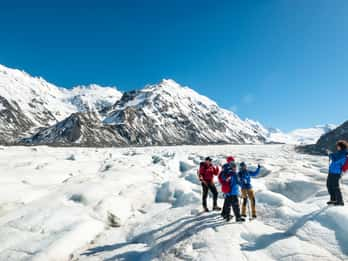
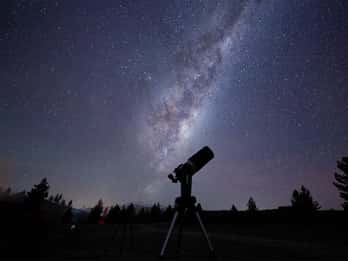
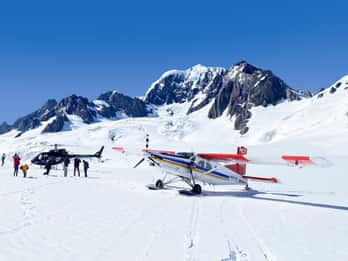
A flight with one leg by ski plane and one by helicopter and a landing on the upper Tasman Glacier, a heli hike with crampons on the same glacier, and an evening with telescopes and blankets beside the Tekapo River.
Ski plane + helicopter, glacier landing · 45 minutes
✓ Free cancellation
from NZ$ 499
Book on GetYourGuideHeli-hike, guided glacier walk · 3 hours
✓ Free cancellation
from NZ$ 995
Book on GetYourGuideTelescopes, loungers, photos · 90 minutes
✓ Free cancellation
from NZ$ 130
Book on GetYourGuideAoraki/Mount Cook rises to 3,724 m, according to a GPS survey by the University of Otago in 2013. It stands in a national park of 70,696 ha where glaciers cover 40 per cent of the ground and 21 peaks top 3,000 m. For Ngāi Tahu the mountain is an ancestor, and in the tribe's Treaty settlement its title passed to Te Rūnanga o Ngāi Tahu, which gave it back to the nation. That is why the dual name is used for the mountain, the park and the village.
Mount Cook Village sits at the end of State Highway 80 and is small: there is a DOC visitor centre, a card-only fuel pump and no supermarket or bank. The nearest shop is in Twizel, about 65 km away. The Hooker Valley Track starts at White Horse Hill car park above the village and takes about three hours there and back.
Weather decides most plans. The village receives more than 4,000 mm of rain a year, with rain on about 14 days a month, while Lake Tekapo, 104 km away, gets only 500 to 600 mm and is often among the five sunniest places in New Zealand. The basin around Tekapo and Lake Pukaki is one of the driest parts of the country, so a wet day in the valley can still be a fine one by the lakes. The month-by-month guide covers icebergs in summer, ice on the lakes in winter and how much daylight you get.
The Department of Conservation treats October to April as the peak season, and this is when the walking tracks are at their best. From May to September the days are shorter (about nine hours of daylight in June), shaded parts of the Hooker Valley Track can be icy, and the long nights suit stargazing.
Allow about 4 hours 15 minutes from Christchurch, which is roughly 324 km. For Queenstown the published times range from about 3 hours 15 minutes to 5 hours for around 258 km. InterCity runs a daily bus between Mount Cook Village and Christchurch that takes about 4 hours 55 minutes.
The operators fly all year and land on glaciers or snowfields at height, but a snow landing is not guaranteed in summer, and their own figures for how often it happens differ. Flights are cancelled in bad weather, and the tour pages promise a refund or a new time when that happens.
Most of them start in Lake Tekapo, either on the summit of Mount John or at sites a few minutes from the village. Others run from Twizel. The whole area lies inside the Aoraki Mackenzie International Dark Sky Reserve, which covers 4,367 km².
No. Visit Mount Cook is an independent guide. The national park and its visitor centre in the village are run by the Department of Conservation (doc.govt.nz), and the official regional tourism site is Mackenzie Region (mackenzienz.com), run by the Mackenzie District Council.
Tours from NZ$ 59
Compare tours